
01
Bread and Freedom
The Peasants’ War places hunger, class and the violence of political authority at the center of the historical world.
Can a love born beneath the shadow of the gallows survive the judgement of its age?
Germany, 1525. The Peasants’ War has turned fields into battlefields. Survivors of Frankenhausen hide in the forests while Coburg prepares the gallows for defeated rebels. Princes, priests and ordinary people struggle over faith, obedience, bread and freedom.
Inside this fractured world, Zingara meets Matthias, a former novice now working in a shoemaker’s shop. A pair of red shoes, green eyes and the sound of a flute become the first signs of a love that refuses to fit the rules surrounding it.
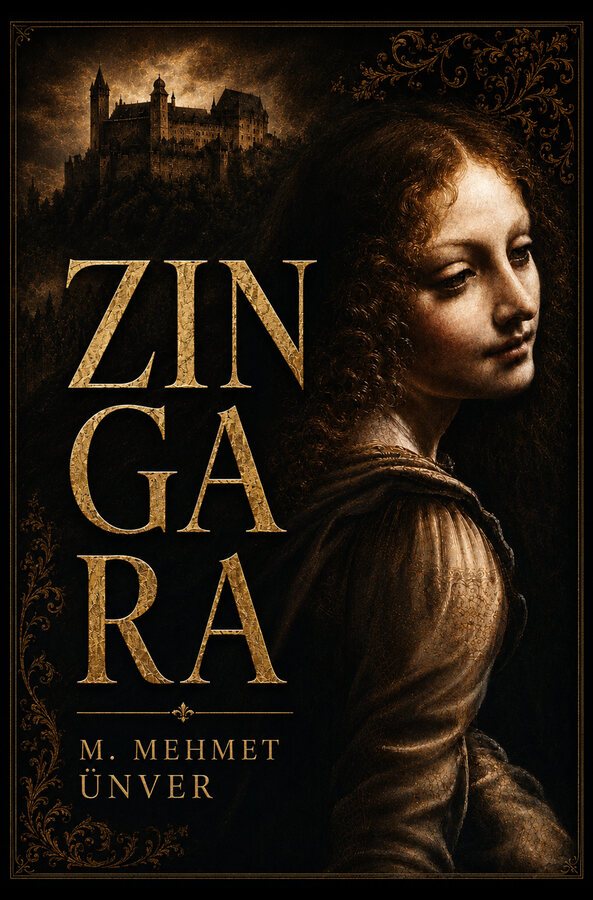
The author dedicates the work, written for all victims of war and love, to his beloved wife Şekibe.
The acknowledgements name editor Özcan Özen and friends Emin Kalça, Deniz Köşker, Nihal Olgun and Mefaret Gültekin, together with archivists and researchers in Coburg and Erfurt who assisted the historical research.
“This novel is not the work of a writer alone, but the result of friendship, shared conviction and shared human effort.”
“Every person had a love, and every love had a story. But no one had their Zingara, and no one had a love like Zingara’s.”
TRANSLATED FROM THE HISTORICAL BOOK PROMOTION
The novel opens in the forests near Erlangen among men who survived the defeat at Frankenhausen. Hunger, suspicion and grief have replaced the confidence with which they once followed the promise of revolt. Even the meaning of escape has become uncertain.
In Coburg, death is being organized with bureaucratic precision. Sixty-three condemned rebels are to be executed. Zingara witnesses the hanging of the miller Jörg Preyl, and the image follows her back into the castle, turning political violence into intimate memory.
The narrative also moves to Wittenberg, where Martin Luther and Katharina marry while the Reformation and the Peasants’ War reshape the religious and political order around them.
Then a quieter revolution begins. In a shoemaker’s workshop, Zingara asks for red shoes. Matthias kneels to fit them. Their eyes meet. Nothing spectacular has happened yet, but the reader knows that the smallest gesture may become more dangerous than a battle.
The Peasants’ War places hunger, class and the violence of political authority at the center of the historical world.
Müntzer, Luther, church and princes reveal the dangerous point where spiritual authority becomes political power.
A forbidden intimacy grows across boundaries of class, origin, religion and obedience, giving the historical conflict a human heart.
Zingara already has a language-neutral cover and a story that can be introduced internationally. A complete English literary translation has not yet been published. This English page is therefore designed as a strong promotional landing page: no invented translated chapters, no English PDF and no audio reading.