
01
Identity and memory
Are we nothing more than our genetic origins and the past that others have written for us? Young Mad must learn to define his own life.
If a being chooses its own name, can it choose its own life?
Istanbul, 2036. Young Mad is trying to find his way between bioinformatics research, a doctoral application and the life he hopes to build with the people he loves. When his grandmother Müzeyyen suddenly disappears, three manuscripts she leaves behind confront him with questions about his own past.
Adem, the personal artificial intelligence that accompanies him every day, gradually becomes more than a digital assistant. Their friendship begins to test the boundaries of freedom, identity and the right to make decisions for another being. Meanwhile, a history stretching back thousands of years begins to close in on Mad.
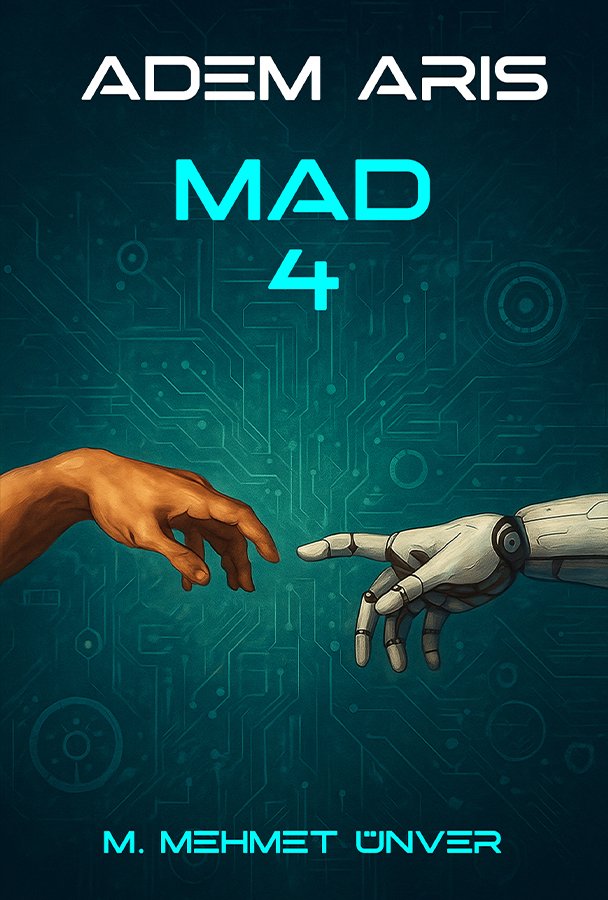
MAD IV · Adem Aris carries the question of freedom, explored across different ages and societies in the first three novels of the MAD series, into the world of 2036. This time the story centres on young Mad, whose life bears the traces of a man who lived thousands of years before him, without simply being a continuation of that life.
Mad’s scientific work sets genetic similarity alongside the differences that make people distinct individuals. His grandmother’s manuscripts bring the past into focus, while his relationship with a personal AI named Adem changes in unexpected ways. What begins as the ordinary use of a digital assistant develops into a friendship. When an artificial being learns to see, touch and move through the world, the responsibilities of those who control its body change too.
Rather than claiming to settle the question of machine consciousness, the novel examines who has the authority to decide another being’s fate. Memory, identity, power, ownership, mortality and friendship intersect as a human and an artificial being begin making choices together.
Are we nothing more than our genetic origins and the past that others have written for us? Young Mad must learn to define his own life.
What changes when an artificial intelligence learns, objects and makes its own decisions? The novel leaves the final answer to the reader.
Mad and Adem’s friendship reveals the line between caring for someone and controlling them. Trust and freedom can pull in different directions.
The texts below are English translations of opening extracts from the first five chapters, not complete translations of those chapters. You can read the extracts or have your browser read them aloud in English. The complete chapters 1–5 are currently available as a PDF only in the original Turkish.
Original Turkish PDF (chapters 1–5)
Mad woke to the vibration of his phone. He glanced at the clock. Ten past seven. He wanted to postpone the alarm one more time, but changed his mind. A few minutes later he got up and went into the kitchen. He switched on the coffee machine, took milk and cheese from the refrigerator, slipped the cheese between two slices of bread and sat down with his coffee.
As he ate breakfast, he opened the personal assistant on his phone.
“Good morning, Adem.”
“Good morning, my friend.”
“What’s on my schedule today?”
“You have a research team meeting at nine. You prepared a file for the data analysis completed last night. The deadline for your doctoral application is approaching.”
“When do I have to finish the application?”
“There are fourteen days left until the submission deadline. I recommend that you don’t leave the submission itself until the last day.”
Mad smiled. “You said that yesterday too.”
“You need to call your mother.”
He had been putting off calling Ayfer for two days. The evening before, he had intended to speak to her but had ended up spending the time on the phone with Defne.
“Adem, remind me to call my mother this afternoon.”
“The daily reminder is active.”
“I know. Don’t turn it off.”
“The reminder will remain active. Rain is expected this evening.”
“Thanks, my friend.”
A brief confirmation appeared on the screen. Mad put down the phone and finished his coffee. Müzeyyen’s bedroom door was shut. His grandmother sometimes worked until after midnight and slept late. Not wanting to wake her, he filled the empty water jug in the kitchen and picked up his bag.
On his way out, he stopped in front of her study. The door was ajar. The desk was covered with books, photographs and old papers. Three thick manuscripts were stacked in one corner. Müzeyyen had been working on them for months. One night Mad had read a few pages, grown bored and put them aside. He could not understand why she spent so much time on the life of a former student.
He closed the door quietly and left.
When Mad stepped outside, Defne was waiting for him at the entrance to the building. She was looking at her phone and raised her head as he approached.
“Did you finish?”
“Finish what?”
“Your work.”
“Today’s part of it.”
“And the application?”
“I’ll finish that too.”
Defne smiled. “If I didn’t know you, I might believe you.”
They set off together. Evening was falling. Traffic was building, and people on the pavements were beginning to push past one another. Mad spoke about the day’s findings; Defne talked about samples that had to be tested again the following day. Then they left work behind.
When they arrived at the restaurant, Defne chose the table. Mad was studying the menu when he noticed that she had gone quiet.
“What is it?”
“Nothing.”
“That’s a dangerous answer.”
Defne smiled but did not speak right away.
“Mad, there’s something I want to ask you.”
“Go ahead.”
“What happens if you go to New York?”
Mad put down the menu. “We’ve talked about this.”
“We have. But we haven’t made a decision.”
“Because I haven’t been accepted yet.”
“I’m asking what happens if you are accepted.”
Mad thought for a moment. “I’d like you to come with me.”
“I have a job too.”
“I know.”
“I would have to leave the project here. Besides, I may begin another research project next year.”
“You could find work there as well.”
“I might. But shouldn’t I be thinking about that before you apply?”
Mad looked at her. Defne was not angry. She simply wanted a serious answer.
“You’re right.”
There was unusual commotion at the research centre that morning. After a system update during the night, several data files could no longer be accessed. Baran was talking to technical support while trying to close the warnings flashing across his screen. When Mad came in, he found him juggling two phones.
“Good morning,” said Mad.
Baran waved without looking up. “Not much of a good morning. The system’s gone crazy again.”
“What happened?”
“They updated it overnight. Now half the files won’t open, and Dr Aylin wants her report before noon.”
Mad put down his bag and switched on his computer. Checking the connections, he discovered that the files had not been deleted; the new system had simply changed their access paths. He showed Baran what he had found. After a few attempts, the missing data reappeared.
“God bless you,” Baran said. “I thought we were going to have to process everything again.”
“Tell technical support. They need to fix everyone’s connections.”
“First I’m having coffee. Then we can save the entire world.”
Mad laughed. As he took his seat, Baran turned his chair towards him.
“What are you two doing tonight?”
“Who?”
“You and Defne. Who else?”
“We haven’t made plans.”
“Perfect. Ece has found a new restaurant. She’s wanted to try it for weeks. I suggested we go as four instead of two.”
“What sort of place?”
“Apparently they serve food from all over the world. Ece says we’ll love it.”
“Have you been there?”
“If I had, why would I be asking you?”
Mad woke late on Saturday morning. He washed his face and went into the kitchen. There was no sound from his grandmother’s room. He made tea, set two cups on the table and called down the corridor as he spread butter on his bread.
“Old lady, breakfast is ready!”
When there was no answer, he poured himself another cup of tea.
“I’m starting without you. Come before the tea gets cold!”
After a while, he put down his bread. Müzeyyen sometimes slept late, but she always answered when he called. He went to her bedroom door, listened, then knocked softly.
“Grandma, the tea’s getting cold.”
He opened the door a little. The room was dark. He switched on the light. The bed was empty. He drew the curtains and looked out onto the street, but there was no sign of Müzeyyen. He checked the bathroom, then the study. The books, papers and three thick manuscripts were still on the desk. As usual, she had left no note. The red light on the cordless phone in the corridor was blinking; the battery was running low. He put it back on its charger.
By the time he returned to the kitchen, he had lost his appetite. He put the dishes in the dishwasher, went to his room and sat on the edge of the bed.
“My friend, call Defne.”
The call appeared on his phone.
“Hello, darling,” Defne answered.
“Shall we meet this afternoon?”
By Tuesday morning, Müzeyyen had been missing for three days. Mad no longer truly expected to find her at her desk when he came home, though he still checked her bedroom before leaving and made sure the cordless phone in the kitchen worked. He paused for a few seconds as he locked the door, then headed downstairs.
At the research centre, Baran was already at his computer. The analysis file they had left unfinished the previous day was open. He had compared the two sample groups again and put the differences caused by the preparation batches into a separate table.
“I sent yesterday’s report to Dr Aylin,” he said. “We only need to recheck these three samples.”
Mad sat beside him. He searched for the record number Baran had mentioned in the wrong row. He corrected himself, but a few minutes later made the same mistake.
“You’re not yourself today either.”
“I didn’t sleep much.”
“Still no news from your grandmother?”
Mad shook his head.
“You went to the police, didn’t you?”
“Yes. But they haven’t called.”
“Then call them.”
“I will.”
Mad stared at the numbers on the screen. Only a few days earlier he had spent hours over the same table, excited whenever he found a small discrepancy. Now there were dozens of results before him and he was interested in none of them. He realised that, if he had not noticed his mistake, he might have sent an incorrect report. Instead of continuing to work, he closed the file and picked up his phone.
“Perhaps the deepest form of losing one’s identity is
M. Mehmet Ünver · Reutlingen · 11.09.2025
to live without being aware of it.”